
ByOurRep

West Palmdale: The Honest Neighborhood Guide
From a Guy Who's Driven It His Whole Life
Let me take you on the drive I know by heart — Division Street, heading west.
📍 LA County· West side of Palmdale 🧭 West of Division Street ✉️ ZIP 93551 🏫 Several local school districts
The West Palmdale guide
nobody else can write
Let me take you on the drive I know by heart — Division Street heading west, from the older heart of town out toward the foothills and the San Gabriels, where the newer, pricier stuff climbs into the hills.
I've lived in the Antelope Valley over 40 years, and here's the thing nobody selling you a house on this side of town wants to say out loud: West Palmdale gets marketed as the automatic "nice half," and that's not the whole story. Is it the more developed side? Yeah — the mall's over here, the newer master-planned communities are over here, the parks and the country club are over here. That part's true, and I'll walk you through all of it. But "west side" is a range, not a promise. There's older, modest housing out here that's been standing for decades, sitting a few miles from brand-new gated communities selling for double. Same "West Palmdale" on the address. Very different house. Sometimes what you're really paying for is the label, and the label does more work than the actual street.
So let's just drive it. Division Street, heading west — and I'll show you where the lines
really are, including a few the maps don't draw.
Here's the short version if you're just trying to decide: on the west side you're paying for the more
developed half of Palmdale — the mall, the parks, the newer master-planned communities
— but "West Palmdale" covers a huge range, from decades-old modest tracts to brand-new gated hills,
and the premium's only worth it when it's buying you something real. Whether a specific street is worth
it is a block-by-block question, not a ZIP-code one. But first, let me show you what this side of town
really is — because that's the part nobody else can tell you.
— The Line
Where the west side starts — Division Street
Same divide as the east side, worked from the other direction — I walk the same line from the Plant 42 side over on my East Palmdale neighborhood guide. Palmdale's whole address grid runs off one spine: Division Street. Everything numbered "East" or "West" is measured from Division — same system as Lancaster — so the "West" in West Palmdale is literally built into your address.
Here's the part that trips people up: "west" doesn't mean one thing. Locals call the whole western stretch — the west sides of Palmdale, Lancaster, and Quartz Hill — "The Westside." Loosely, folks think of West Palmdale as everything west of the 14 Freeway, even though plenty of 93551 addresses run east all the way to Division. So the closer-in stretches near Division include some of the older housing in town, while pushing west takes you through established Rancho Vista, then newer construction, and eventually the higher-end gated stuff climbing into the hills. A "West Palmdale" address can land you anywhere on that spread — and that distinction matters when you're buying. It's the kind of thing a local catches and a search engine doesn't.
— The Range
West Palmdale is a range, not a guarantee
This is the honest core of the whole page, so I'll say it plain: the west side runs from decades-old
and modest to brand-new and pricey, and the "West Palmdale" name covers all of it.
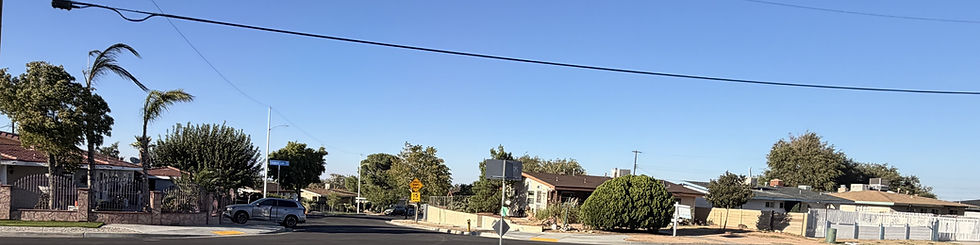
The older west-side tracts — established streets, grown-in landscaping.
📷Photo by Brian Watters.
The older west side. Some of the older tracts out here sit around 10th Street West and Lake Elizabeth Drive — built years ago, back when this was closer to the edge of town. They built out and wrapped right around a school, and over the years newer developments grew up around them. So today you'll find a decades-old street a short drive from a 2020s gated community. Neither one's "better" in the abstract — it depends what you want and what you're willing to pay for. But if somebody tells you "West Palmdale" like it's a single quality tier, they're selling, not telling
The newer west side. On the other end you've got the master-planned communities — Joshua Ranch (City Ventures), built up toward the hills, all-electric, solar-equipped, and gated. This is the "nice half" people picture — and it prices like it.
What that means for you. You pay for the west-side label, and sometimes the label's doing more work than the actual street. My job isn't to talk you onto the "good side" — it's to walk the specific block with you and tell you whether the premium's buying you something real or just buying you a ZIP code. Both sides of that trade are fine. You just deserve to know which one you're making.

An established west-side street — one end of a range that runs from decades-old tracts to brand-new gated hills.
📷Photo by Brian Watters.
— The Boom
Why the west side looks the way it does
If you want to understand West Palmdale, you have to understand what happened here between about 1980 and 2005 — because most of what you see on this side of town got built in that one wild stretch.
Palmdale didn't grow. It exploded. In 1980 the whole city had about 12,000 people. By 1990 it was pushing 69,000 — that's roughly five times bigger in ten years. The city's own records put the 1986 population around 23,000; today it's about 167,000. Palmdale was one of the fastest-growing cities in the entire country through those years — it's literally a textbook example of what planners call a "boomburb," a suburb that grew to big-city size in a single generation.
Here's why it matters when you're buying: the west side IS the boom. Rancho Vista opened in 1985. The Antelope Valley Mall opened in 1990 — both a symptom of the growth and an engine of it, pulling the whole valley's shopping over to this side. The auto mall, the big boxes, tract after tract of affordable single-family homes — all of it landed on the west side in that same twenty-year window, marketed to families priced out of the LA basin who could drive the 14 to a brand-new house they could actually afford. That's the DNA of West Palmdale: a lot of it was built fast, built for commuters, and built in a hurry to keep up with people pouring in.
A lot of that range is just when a given piece got built. The homes from the '80s boom, the ones from the early-2000s wave, the brand-new gated stuff still going up in the hills — they're all "West Palmdale," and knowing which era you're standing in tells you a lot about the house. That's the read I bring to a walkthrough.
— The Retail Spine
Where the whole valley ends up shopping — 10th Street West
The east side leans warehouse-and-aerospace, and the west side is where the whole valley comes to shop
— the center of that is 10th Street West, right where the mall and the big-box node sit.
(The west side's got its own big employer now too — more on that down in the working-west-side section.)
The Antelope Valley Mall. Opened in September 1990 at 10th Street West and Rancho Vista — right in the thick of the boom I just described — it's the only regional enclosed mall in the whole Antelope Valley, about a million square feet, developed by Forest City, with anchors like Macy's, JCPenney, and Dillard's. (Bit of trivia: the Dillard's here is often noted as the chain's first Southern California store.) When it landed, it pulled the whole valley's shopping over to the west side and never gave it back — people still drive in from Lancaster, Rosamond, even the Kern River Valley to shop here.
And like every mall in America, it's ridden the waves. It's been the shopping heartbeat of Palmdale for thirty-plus years, and if you grew up here you watched the anchors and restaurants come and go. Sears closed in 2020 and that big anchor still sits empty. The old Gottschalks stores went under back in 2009, and Macy's moved into one of those buildings the next year. Mervyn's became a Forever 21, which closed too — and that space is being reborn as a Round 1 arcade-and-bowling spot. Restaurants have done the same dance: Claim Jumper came and eventually went; places like Yard House stuck around. New owners bought the mall in 2022 and are working on revitalizing it. None of that means the mall's dying — it means it's turning over, which is what living retail does. It's been the heartbeat of Palmdale — maybe of the whole Antelope Valley — for more than thirty years. The heartbeat may slow, but it keeps on ticking; the faces on it just keep changing.


📷 The Antelope Valley Mall — the only regional mall in the valley, Macy's in the old Gottschalks building, and Sears sitting empty since 2020.
Turnover, not death. Photos by Brian Watters.
Sam's Club and the big boxes. Right in that same 10th West node you've got Sam's Club (opened 2003) and the live Walmart Supercenter — the current one, alive and kicking. Between the mall, the warehouse club, and the surrounding centers, 10th West is the busiest retail corridor on this side of town. This is the live, thriving part — worth being clear about, because the ghost version of this story (below) is a different address.
And the home-improvement story, from experience. Here's a real one, because I've lived it. When I was doing projects out at my place in Littlerock, for years your only serious big-box option was the Home Depot over on West Avenue P, next to the old Walmart. Then they built the Lowe's on the west side of the freeway — and that was it, those two. Sure, you could hit a smaller hardware spot for odds and ends, but for real big-box selection and prices you were driving to the west side. And if you were out running sprinkler lines on a Saturday and forgot one fitting? That was a twenty-minute drive back across town, each way, to grab a fifty-cent part. Anybody who's done a weekend project out in the east valley or Littlerock knows exactly that pain. (These days the east side finally has its own Home Depot too — but for a long time, the west side had the hardware.)
— The Planned West
Rancho Vista, Anaverde, and the community
they promised for thirty years
The west side is where Palmdale did most of its big planned building — and each of these has its own story, including one that took thirty years to get off the ground.
Rancho Vista. The Rancho Vista Development Company set out in 1984 to build an ambitious master-planned community in West Palmdale, and it opened its doors in 1985. The name's just Spanish for "ranch view," but the thing itself became the west side's calling card — established neighborhoods, schools, shopping, a golf course. When people say "the nice part of Palmdale," Rancho Vista is a big part of what they're picturing.
Anaverde. Out in the western foothills off Avenue S, Anaverde is a master-planned community that started building around 2004–2005 — they leveled and graded into the hills back there and built a whole community with its own parks and elementary school. It was originally called City Ranch, and it's still growing today as Anaverde Nuevo. Up on the ridges you've got Ana Verde Hills, gated homes that overlook Lake Palmdale — which, fittingly, sits right in the little Anaverde Valley between the San Andreas Fault and the hills. Big views, big lots, big prices.
⚠️ Buying up against the hills? Ask about the second way out.
Here's a detail most listings won't tell you. Anaverde backs right into high fire country, and getting a second way out of a foothill community matters when a fire's moving. The city's own project record shows additional road was built specifically for emergency access — Avenue S extended across the Ritter Ranch land out to Elizabeth Lake Road, so the area isn't stuck on a single route. If you drive out there you'll see it: a road running out with block walls staged along it for future development that hasn't gone in yet. It's the kind of thing you never think about until a fire's coming and everybody's trying to leave at once — and it's exactly what I'd want you clear-eyed about before buying anywhere up in these foothills. Fire country also means a real conversation about insurance — have that one with your insurer early, because coverage and cost out here aren't the same as down on the valley floor.
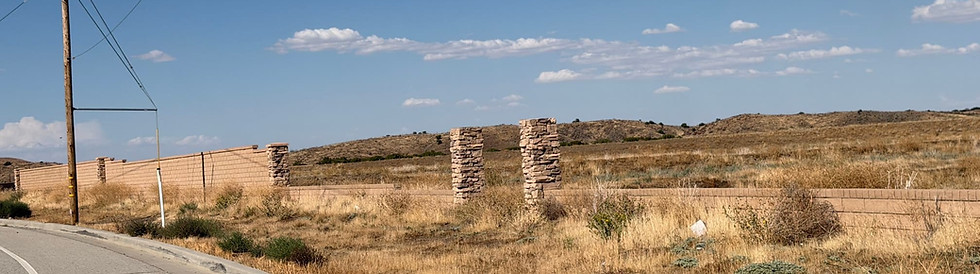
Out past Anaverde: block walls and entry pillars staged for homes that aren't built yet, along the road they ran to Elizabeth Lake Road for a second way out.
📷 Photo by Brian Watters.
Ritter Ranch — the community they promised for thirty years
This one's worth telling straight, because it's the west side's great cautionary tale. Back around 1990, developers planned a giant master-planned community — 10,500 acres south of Elizabeth Lake Road, west of Anaverde, originally pitched at roughly 7,200 homes with a golf course, schools, the works. Then it stalled. Defense cutbacks gutted the housing boom, the developer went bankrupt in the mid-'90s, the special-district bonds defaulted, 2008 knocked it down again — and decade after decade, not a single house got built.
Here's the honest, current status, because I'd rather you have it straight than hyped: as of the latest city records I've seen, there still aren't any homes actually built out there. What you'd see if you drove it now is grading and backbone roads from years back. But it is still an active project on the city's books — the specific plan still calls for thousands of homes, and new tract maps for the first phase have been moving through the city, so it's genuinely further along than it's been in a long time. Just know that "in the pipeline" isn't the same as "built," and after thirty years of false starts I'd want you to know exactly where it really stands — I'll pull the current phase status and any assessment districts on a specific parcel before you count on anything. And because it backs right up against real fire hazard, foothill fire access and insurance are worth asking about here the same way they are anywhere up against these hills. Not to scare you off. Just so you go in with your eyes open.
— Horse Country
White Fence Farms
Not all of West Palmdale is tract homes and gated hills. Out toward the northwest, running up against Quartz Hill, is White Fence Farms — a big-lot, horse-property area that dates back to 1951 and has been developing ever since. Think acre-plus parcels, room for horses and arenas and outbuildings, a genuine country feel a few minutes from the mall. It straddles the loose line between West Palmdale, Quartz Hill, and Lancaster — which tells you something about how blurry those borders really are out here (more on that below). If you want land and animals without driving to the far edge of the valley, this is one of the pockets people look at.
— The Map vs. The Ground
Where one place bleeds into the next
Half of knowing this side of town is knowing that the map lines and the real lines don't match. A couple worth knowing:
Where Palmdale runs into Quartz Hill. Quartz Hill isn't its own city — it's an unincorporated community that shares its name and its edges with both Palmdale and Lancaster. There's no "Welcome to Quartz Hill" line where West Palmdale ends; the neighborhoods just bleed together out along the northwest, and your address can say one thing while the neighborhood feels like another. I've watched buyers fall in love with a "Quartz Hill" house that's really West Palmdale, and vice versa. It matters for schools, for taxes, sometimes for price — so it's worth having somebody who knows which side of an invisible line you're actually standing on. (Quartz Hill's got its own page because it earns one.)
Godde Pass — the way west to Leona Valley. If you head out the far west side toward Leona Valley, you go over Godde Pass — the north entrance to that valley, an extension of 60th Street West. It's named for the Godde family: Fred Godde bought property in Leona Valley back in 1901 for hay and grain, and the pass carried the family name. Little piece of pioneer history you drive right over on your way to cherry country.
— The Fault Under All Of It
The San Andreas runs right through it
You can't honestly talk about the west and south side of Palmdale without talking about the ground it sits on — because the San Andreas Fault runs right through it.
Right at Avenue S and the freeway. If you exit the 14 at Avenue S and look at the hillside just north of Lake Palmdale, you're looking at the Palmdale Road Cut — one of the most famous exposed slices of the San Andreas anywhere in California. When the crews blasted through the rock to build the freeway, they accidentally peeled open the fault zone and left it on display: layers of stone folded and twisted like ribbon by millions of years of the Pacific and North American plates grinding past each other. And here's the local kicker — that warped rock is the Anaverde Formation, which takes its name from the same Anaverde Valley the community up in the hills is named for. Same old local name, the fault's handiwork on full display right underneath it. (There's no official trailhead — locals know to take the first dirt road west off Avenue S and walk up. You just have to know it's there. It's the shot at the top of this page.)
Where it goes from here. From that road cut, the fault runs northwest — it skirts the southwest edge of Lancaster and then runs right along Elizabeth Lake Road, out through the community of Elizabeth Lake and on toward Gorman. That's the same Elizabeth Lake corridor everything else on this side of town ties back to: it's where Anaverde's emergency access route runs out, and it's the road you take west toward Leona Valley over Godde Pass. The fault is the reason the hills sit where they sit and the lakes formed where they formed.
⚠️ What the fault means for a buyer — straight
Look, the whole Antelope Valley lives near this fault; it's not a West-Palmdale-only thing, and it's not a reason to not buy here — millions of people live along the San Andreas. But if you're buying up against the south and west foothills especially, it's worth knowing it's there, and it's worth a real conversation with your insurance person about earthquake coverage. That's a separate policy from standard homeowner's, and it's a your-specific-situation question for a licensed pro — not something I'd wave off or oversell. I'd rather you know what you're standing on and decide for yourself than find out later.
— The Working West Side
Water, the aqueduct, and the landfill
The farther west you go in Palmdale, the more the land does two things at once: it climbs up into the foothills, and it carries the infrastructure that keeps the whole valley running. This is the part of the west side nobody puts in a listing — but it's exactly what an honest buyer should know is out there.
The aqueduct along the edge. Run out to the far west and you'll hit the California Aqueduct — the big open concrete channel that carries State Water Project water across the whole valley. Out around 70th Street West there's even an "Aqueduct Vista" spot. That aqueduct runs right along the edge of these west-side neighborhoods and threads across the entire Antelope Valley — it's a big part of why there's a valley here at all. This is imported water; the desert doesn't grow a city like Palmdale on its own.

The California Aqueduct along the west edge — imported water is the reason there's a city here at all.
📷 Photo by Brian Watters.
AVEK — the west end of Avenue N. Out at the west end of Avenue N (around 6500 W Ave N) sits the Antelope Valley-East Kern Water Agency — AVEK. This isn't a little neighborhood pump house; AVEK is a big deal. It's a regional water wholesaler chartered back in the 1950s, and it's one of the largest State Water Project contractors in California — the agency that actually imports aqueduct water into the valley, treats a big share of it, and sells it on to the local retail districts. So when I said the aqueduct is why there's a city here, AVEK is a big part of how that water actually gets to your tap.
The landfill — and how it's actually run. Out on the west side at City Ranch Road is the Antelope Valley Public Landfill (the Antelope Valley Recycling and Disposal Facility, run by Waste Management). It's the valley's major dumping ground — and I'll be straight, "landfill on the west side" is the kind of thing that makes a buyer flinch. But here's the honest picture: the operation has stepped way up over the years. The landfill itself doesn't take hazardous waste — instead there's a permanent Environmental Collection Center on-site (a partnership between Palmdale, Lancaster, the county, the state, and WM) where residents drop off household hazardous stuff like paint, batteries, and chemicals for free, so it's handled right instead of ending up in the ground or a storm drain. And like every modern landfill, it runs an active methane capture and mitigation program — the gas that a landfill naturally produces gets collected and managed under air-quality permits rather than just venting off. None of that makes a landfill invisible, and if you're close to it, wind direction is a real thing to check on the day. But it's a far more managed operation than the word "dump" makes people picture, and I'd rather walk you through it honestly than pretend it isn't there.
Trader Joe's — a west-side employer, not just a store. Here's the one that complicates the tidy "east side has all the jobs" story. On the southeast corner of Avenue M and 10th Street West, Trader Joe's built and now runs a massive food-assembly and distribution facility — a roughly 104-acre site, over a million square feet across a hub building, a freezer building, and an accessory building. It's a project the city pegged at 800 to 1,000 jobs, entry-level to management — real local work on the west side, in a valley where tens of thousands of people still commute down the hill every day. They even set aside a 12-acre Joshua tree preservation area on the site, a nod to what the land was before. So when I tell you the jobs story isn't only an east-side thing anymore, this is Exhibit A.
— Worth Knowing
Landmarks worth knowing
Some places on the west side you should just know about — a few worth seeing, a few that are part of the local fabric.
Marie Kerr Park + the Palmdale Amphitheater. On the northeast corner of 30th Street West and Rancho Vista Boulevard sits Marie Kerr Park, and this one's more than a park — it's basically the west side's backyard. Fifty-seven acres, and they packed it: the Palmdale Amphitheater (the premier outdoor concert venue in the whole Antelope Valley), a community pool, a skate park, the Best of the West Softball Complex, walking paths, playgrounds, a rec center. It's not just the things a park needs — it's the things a whole side of town needs, all in one spot. Summer concerts out here are a valley tradition, and on any given weekend it's where the west side shows up.

The Palmdale Amphitheater at Marie Kerr Park — the premier outdoor venue in the valley, and the anchor of the west side's biggest park.
📷Photo by Brian Watters.
Amargosa Creek Trail — and the big water project behind it. Out at Elizabeth Lake Road and 25th Street West, the Amargosa Creek Trail is a genuine desert-nature stretch — a 50-acre habitat with century-old Joshua and juniper trees, walking paths, and interpretive placards. But here's what most people walking it don't realize: the trail is the recreation half of a major water project. The Upper Amargosa Creek Recharge Project pipes State Water Project water off the California Aqueduct into a series of spreading basins out there, where it soaks down into the aquifer beneath Palmdale — putting water back into a groundwater basin that's dropped more than 200 feet since the early 1900s from all the pumping. It's a joint effort between the City of Palmdale, AVEK, the Palmdale Water District, and LA County — and the pipeline even runs along City Ranch Road, the same road as the landfill. So this one spot does three jobs at once: recharges the valley's water, protects against flooding, and gives you a free place to walk the dog.
Antelope Valley Country Club. Off Country Club Drive, the AVCC has been around since the 1950s — an 18-hole course designed by Bill Bell Sr., 149 acres of green in the middle of the high desert, tennis and pickleball, the whole deal. It's one of the older-established institutions in Palmdale, and part of why the west/central side carried a "nicer address" reputation for decades. That course has outlasted just about everything around it.
Rancho Vista Golf Course. Different course, different vibe: over on Club Rancho Drive, the Rancho Vista Golf Course is a public 18-hole course built in 2000, designed by well-known golf architect Ted Robinson Sr. The course points to golfer voting that's ranked it among California's best public courses — and whatever you make of that, it's lush, well-kept, and a genuine bargain compared to what you'd pay down in the LA basin. One honest local heads-up if you go: the afternoon wind out here is real, west-to-east, most days — so book an early tee time if you want the calm nine.
Highland High School. On 25th Street West, Highland High (the Bulldogs, cardinal and gold) opened in 1989 and anchors a big chunk of the surrounding west-side neighborhoods. Part of the Antelope Valley Union High School District.
🏥 Palmdale Regional has an ER — but it's not a trauma center
Over on Medical Center Drive (off the west side, near the 14) is Palmdale Regional Medical Center, which opened in 2010 — a full hospital with a 24-hour emergency room, one of the two biggest ERs in the valley. Here's the honest, useful part, because it's the kind of thing people don't think about until they need it: Palmdale Regional has a real ER and it's certified for heart attacks (STEMI) and strokes, so for most emergencies it's right there. But it is not a designated trauma center. For a major trauma — a bad car wreck, a serious injury — the valley's only trauma center is Antelope Valley Medical Center up in Lancaster (a Level II trauma center), and that's where those cases get routed. Not a knock on Palmdale Regional at all — it's a good hospital and a real asset to this side of town. Just something worth knowing about how emergency care actually works out here.
A note on movies. People ask if anything famous got filmed out here, and I'll be straight: Palmdale's big-screen moments mostly happen east and south of the west side — out at Plant 42's giant hangars (that's where they flooded a whole fake town for Hard Rain) and out in the desert movie ranches past Lake Los Angeles. The west side's the shopping-and-neighborhoods half, not the film-set half. That aerospace-and-Hollywood stuff all lives on my Palmdale hub and the east-side guide. No sense pretending a movie got shot at the mall. (I've got a soft spot for this stuff — I drive for the studios myself, so I notice when the trucks roll into town.)
— The Way I Remember It
The ghosts of the west side
Every part of this valley has ghosts — the stuff that used to be there that only the people who lived it still see. The west side's are a retail story, mine firsthand from watching (and delivering to) this town for forty years. This is memory, told the way I remember it, not a history book.
The first Walmart in the valley — now Burlington. The valley's first Walmart opened over on West Avenue P back in 1991. When Walmart later built the big Supercenter over on 10th West, they left the Avenue P building — and Burlington moved into it, where it still is. I even heard that Avenue P store was one of the first Walmarts in California — don't hold me to that one, but it was absolutely one of the first out here.
The big Kmart on 10th West. There was a Kmart over on 10th Street West — it was ginormous. When Kmart started consolidating and closing stores, they sold that building, and it got carved up into a whole row of tenants: Ashley Furniture in one part, Michael's in another, BevMo in another, Handel's Ice Cream, and even Turner's gun shop. One big empty box, five new lives.
Circuit City on 10th West — now a gym. Right across from Best Buy on 10th Street West, there was a Circuit City. When the whole chain went under back in 2009, that store went down with it — and the building's an In-Shape fitness club now. Best Buy's still sitting right across the street. If you were around then, you remember those two going head to head — the midnight lines when a new game console dropped, the whole bit. One of them made it, one didn't, and the building found a new life either way.
— How to Read a Neighborhood
How to actually read a neighborhood — anywhere
I'm not going to tell you who "belongs" in West Palmdale or sort people into buckets — first-time buyer, move-up family, retiree chasing the gated hills — because every buyer I've ever worked was their own situation, and pretending otherwise just makes a tidy webpage and a wrong answer.
What actually matters out here isn't the west-side label. It's condition, cost, and fit: how old is the tract and what shape is the home in; what's it really going to cost you once you add taxes, insurance, and any Mello-Roos or HOA on the newer planned communities; whether the specific street fits how you live; and what that west-side premium is actually buying. Sometimes it buys you a genuinely newer, better-built home. Sometimes it just buys you the ZIP. West Palmdale runs the whole range, and "west side" won't tell you which end you're standing on.
This is true here and it's true in any town in California, so let me just say it once and mean it: you cannot buy a neighborhood off a page — not mine, not anybody's. You have to go drive it. And not once. Drive it during the day, drive it at night, drive it on a weekend, because a street can be three different places at three different times.
When you're out there, look at the small stuff. Are the lawns kept up, or let go? Broken-down cars sitting in driveways or out on the street? Are the houses painted and cared for, or falling apart? That's not me telling you who lives there — I can't tell you that and I wouldn't try. It's telling you how a street is being kept, right now, which is real information about what you'd be buying next to. Some of the best people I know live on tired streets, and it cuts the other way too. So don't read it as a verdict on anybody — read it as one more data point, and decide whether what you can actually see out there — the upkeep, the distance, the traffic, the noise — works for how you live. That's the read I'd want somebody to give me. So that's the read I give you.
— The Bottom Line
So — is West Palmdale a good place to live?
Here's my honest answer: it depends on your life, and I mean that as help, not a dodge.
Parts of it are exactly the "nice half" people picture — the mall, the parks, the country club, Rancho Vista, the newer gated communities up in the hills are all real, and they're all over here. The premium's only worth it when it's buying you something real. Some of the best value I've found for buyers is an older, solid west-side home that everybody drove past chasing the new construction.
And on schools — there are several districts out here, and once you get out toward Quartz Hill and the unincorporated pockets the schools can change on you; you want to know exactly what you're zoned for before you fall in love with a house, because that's easy to check and expensive to assume.
Location is and always will be real estate. But I've watched this side of town my whole life, and I can tell you it's a real place with real value — the only question that matters is whether it fits you. If you want somebody who's watched this side of town for forty years to walk a specific street with you — and tell you straight what the price is really buying, and which invisible line you're actually on — that's the whole reason I do this.
West Palmdale questions I actually get asked
Where's the line between East and West Palmdale?
There's no line painted on the road — it all runs off Division Street, which is what every "East" and "West" address in town is measured from. Practically, West tends to mean the mall side and everything running toward the foothills — more shopping, the established Rancho Vista neighborhoods, and the higher-end gated communities up toward the hills. But it's a range, not a single tier, and out on the northwest it bleeds right into Quartz Hill. If you want the full picture of the city and how the areas fit together, start with my living in Palmdale guide — this page is just the west-side piece of it.
Is West Palmdale really the "nicer" side?
It's the more developed side — the mall, the parks, the country club, most of the newer master-planned communities are over here, and yes, values run higher on a lot of it because that's where the demand is. But "nicer" is doing a lot of lifting in that question. There's older, modest housing on the west side too, some of it decades old, and there's brand-new gated construction a few miles away. Same "West Palmdale" address, very different homes. Don't buy the side of town — buy the specific street, and make sure the premium's buying you something real.
What kind of homes will I find in West Palmdale?
A real spread. Older established tracts closer in — like the ones around 10th Street West and Lake Elizabeth Drive — the big established Rancho Vista neighborhoods, horse property out toward White Fence Farms and Quartz Hill, and newer master-planned and gated communities like Joshua Ranch and Anaverde up toward the hills (with the long-delayed Ritter Ranch still working its way toward actual homes). Prices range accordingly. There's no single "West Palmdale house" — which is exactly why you don't shop it by reputation. You shop the specific home, and you make the west-side premium prove it's worth it.
🏠 A West Palmdale Home, Walked Start to Finish
This is what a lot of West Palmdale looks like up close. It's a 5-bed, 3-bath pool-and-spa home on Ironwood Ave, with a 3-car garage, a bedroom and bath downstairs, and hills out back you can walk right up into. Watch for snakes; it's the high desert. Palmdale Regional Medical Center is across the street, and the 14 is about five minutes away. I walked the whole thing so you can see it before you drive out.
Listed by Chad Macke, Realty Executives Platinum. Shared with permission.
Ready to Make a Move in West Palmdale?
Whether you're buying your first home or selling one you've had for years — I know this market and I'll give you the straight story on where the value is right now.
Already own in West Palmdale?
Thinking about selling? Let's talk about what your Palmdale property is worth today.
Brian Watters · Realty Executives Platinum · DRE #01748905 · 661-400-3990